
Friday, 21 September 2012
Debris on the beach

The waves are obviously spreading knotweed around the coast. Obvious really when you think about it.


Monday, 27 August 2012
Beaver kit eating Japanese knotweed

Here is a beaver kit on the river Ericht outside Blairgowrie getting stuck in to the lower leaves of Japanese knotweed. Which of these causes the most problems on rivers?
Pity we did'nt get as much excitement about eradicating JapKnot and other invasives on the Tay as we did in recent years about the beavers.
Well done that Scottish- born beaver...!
Saturday, 7 July 2012
Japanese Rockweed

Friday, 29 June 2012
The ones that got away
We have been busy controlling giant hogweed at several sites but overlooked a fairly big stand on the Longman landfill site.

Dressing up in full PPE was no fun on a hot day, and after cutting a few flowerheads, we decided to spray smaller plants around the edge of the colony, and come back next spring to deal with plants when they are a more manageable size. Caution is the better part of valour.

Wednesday, 6 June 2012
Mink attack
Amazing footage of a mink raiding a kingfisher nest from tonights (06/06/12) BBC Springwatch, here is a link to the site which shows some stills of the attack but you will probably be able to watch again if you go to BBC iplayer.
Highlights how devastating a predator the mink can be wiping out a kingfisher nest in a matter of minutes. This is the case for many ground nesting birds and water voles.
Link:
http://www.bbc.co.uk/blogs/natureuk/2012/06/kingfisher-mink-predation-last.shtml#more
Highlights how devastating a predator the mink can be wiping out a kingfisher nest in a matter of minutes. This is the case for many ground nesting birds and water voles.
Link:
http://www.bbc.co.uk/blogs/natureuk/2012/06/kingfisher-mink-predation-last.shtml#more
Thursday, 19 April 2012
One to watch
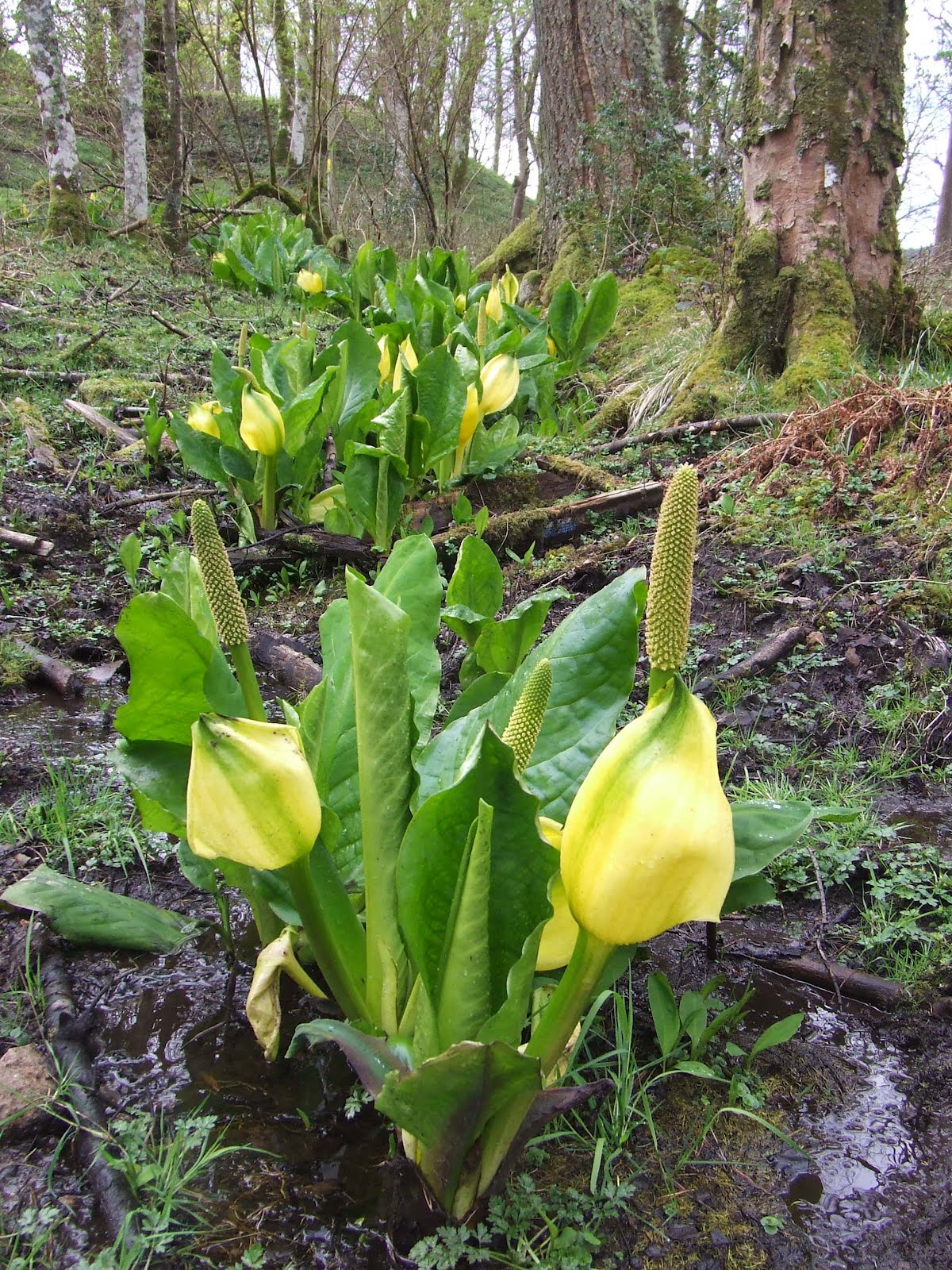
American skunk cabbage was introduced to Britain in 1901, and was first recorded in the wild in 1947. Skunk cabbage is a popular plant in water-gardens, and has been actively promoted by the gardening press. In 1993 Lysichiton americanus received an “Award of Garden Merit” from the Royal Horticultural Society (RHS) Floral Committee.
More recently, greater attention has been drawn to its invasive nature. In 2010, the Recording Invasive Species Counts (RISC) project asked the public to submit records of Lysichiton americanus. The RHS website now provides an online leaflet on invasive plants in which it recommends that gardeners should “Avoid using plants known to be invasive, especially in the case of non-native aquatic species”.
Nevertheless, Skunk cabbage is still praised as a garden plant. The online BBC Plant Finder describes it as “an asset in any bog garden”, and makes no mention of its ability to spread into the wild. Skunk cabbage is still widely available from plant nurseries.
Although it is less invasive than some non-native plants, it is dispersed readily by flowing water. A watchful eye is best kept on any populations which have escaped into the wild. Fortunately, it can be controlled relatively easily.
Note the mass of young plants close to the parents, suggesting that the seeds are not often carried far, unless by flowing water. In the Pacific regions of North America where Skunk cabbage is native, the seeds appear to be dispersed by animals.
However no bears were seen in this wood on the Morvern peninsula.
Thursday, 29 March 2012
BREAKING NEWS! Asian Longhorn Beetle recorded for first time in the UK

"An outbreak of the Asian longhorn beetle (ALB), an exotic beetle pest which could have severe consequences for British trees, has been found in Kent the Food and Environment Research Agency confirmed today. This is the first time an outbreak of this pest has been found in the UK and it is being treated extremely seriously. Fera and the Forestry Commission are taking urgent steps to try to eradicate the outbreak before it has the chance to spread further afield."
"The beetle is not native to the UK, and poses a serious threat to a very wide range of broadleaved trees and shrubs such as maple (including sycamore), elm, horse chestnut, willow, poplar, birch and some fruit trees."
Read more here:
New resource available to identify non native freshwater shrimps and isopods

"The Killer Shrimp is just one of the non-native crustaceans that arrived in Great Britain after invading into Europe. To help raise awareness of this and other species and support detection, Defra have funded the Freshwater Biological Association to produce an identification guide to existing and potential new invaders. "
Booklet is free to download from:
Slaying the giants
 The unmistakable leaves of Giant hogweed have appeared rapidly with recent warm weather.


Tuesday, 20 March 2012
Clash of the Crayfish: Why the Americans Are Winning

Here is a link to a very interesting article highlighting reasearch that has been carried out by the University of Leeds on the affect of the invasive American Signal Crayfish on native White Clawed Crayfish in England and the freshwater ecosystems as a whole: http://www.sciencedaily.com/releases/2012/03/120315095519.htm
"Their study, published in the online journal PLoS One, compares how quickly the two different species deal with food. The American signal crayfish ate up to 83 per cent more food per day than did their native cousins. The research also
showed that white-clawed crayfish are much more choosy about what they eat, preferring particular types of prey, while the signals eat equal amounts of all prey. The white-clawed crayfish are also affected by a common parasite, porcelain disease, which affects their ability to catch prey, leading affected crayfish to eat 30% less. The American signal crayfish, on the other hand, seem unaffected by the parasite."
Here is the link to the published research paper: http://www.plosone.org/article/info%3Adoi%2F10.1371%2Fjournal.pone.0032229
Friday, 16 March 2012
The Economic Cost of Invasive-Non Native Species on GB
This is a report carried out by CABI (the same group who have been testing biological control agents for some invasive plants) on behalf of the UK government.
Not sure if this has been posted before but it certainly has some interesting figures which are worth quoting if you are ever having to justify INNS control work.
https://secure.fera.defra.gov.uk/nonnativespecies/downloadDocument.cfm?id=487
Not sure if this has been posted before but it certainly has some interesting figures which are worth quoting if you are ever having to justify INNS control work.
https://secure.fera.defra.gov.uk/nonnativespecies/downloadDocument.cfm?id=487
Wednesday, 14 March 2012
BREAKING NEWS!

KILLER SHRIMP FOUND IN THE BROADS!!
"Andrea Kelly Senior Ecologist for the Broads Authority said: ‘The shrimp were found through a dedicated monitoring programme. Fortunately we’ve only found the shrimp in a very localised area in the Broads so far. People checking, cleaning and drying their equipment after use is essential to help stop the spread of all non-native species and we would really appreciate their full cooperation in doing this."
Thursday, 23 February 2012

If you can't beat them, eat them.......apparently. Not sure this is actually a good idea.
http://www.bbc.co.uk/news/uk-scotland-south-scotland-17113916
Tuesday, 7 February 2012
Ladybird decline driven by 'invading' harlequin

'Ladybirds native to the UK and other European countries are declining fast as the invasive harlequin species spreads, scientists have shown'
Follow the link to view the BBC news article: http://www.bbc.co.uk/news/science-environment-16916726
Biobullets for Zebra mussels

An interesting read through the following link to a BBC news article on a control technique for Zebra mussles:
http://www.bbc.co.uk/news/business-16788183Thursday, 2 February 2012
UK Crayfish website

Visit the Buglife UK Crayfish website to find out about all crayfish species present in the UK. There is lots of info on Non Native crayfish
http://www.buglife.org.uk/conservation/currentprojects/Species+Action/UK+Crayfish+Website/Crayfish+for+professionals/Non+native+crayfish+and+disease
Monday, 16 January 2012
Be a citizen scientist and stop the spread of invasive species in Britain

'The Observer Ethical awards have teamed up with the University of Hull to help record data on invasive species, so that scientists can monitor their spread and their effect on their local environment. The list of Britain's top 10 unwanted non-native invasive species is listed below. Over the next few months we're asking you to keep an eye out for these species and to photograph and catalogue whenever you can, sending this vital data off to the organisations listed in each box'
'Invasive non-native species: Attack of the Aliens'

A recent article from The Observer on INNS. Very good in my opinion!
Saturday, 7 January 2012
Scottish Mink Initiative update

http://web83.extendcp.co.uk/scottishmink.org.uk/news.html
Click on the link to view the Scottish Mink Initiative Dec 2011 newsletter. Includes updates from all project areas and details of upcoming events.
'Waging war on rhodies'

Follow the link to view the recent article from Trout and Salmon magazine on the Rhododendron clearance project currently underway on the River Orrin.
Thursday, 1 December 2011
INNS Control - South West Scotland
Just to let you all know that it is
not just up north that INNS control is taking place and we are running an INNS project down here on the River Annan. We have been battling
the usual suspects of Japanese knotweed, Himalayan balsam and American mink.
Japanese knotweed has been treated using the
stem injection system and the impact on the plant in the first year has been
extremely encouraging. We aim to inject all visible stems that are large enough
and results can normally be seen after 2 weeks. We have managed to treat around
80% of the known knotweed in the catchment at least once using this method.

To control Himalayan balsam we
have been working with the Criminal Justice Service (CJS) who have provided
teams of unpaid workers (as they are now called) who have been cutting and hand
pulling balsam along the river. As part of the project 5 of the unpaid workers
received Lantra brushcutter training increasing their chances of future
employment. Unfortunately as with many places the Himalayan balsam population
has literally exploded this year covering 3 or 4 times as much of the catchment
as in the previous years.

American mink control has been
more successful and the number of mink in the upper catchment has been heavily
reduced. This is being backed up by the number of prints recorded on rafts as
well as anecdotal evidence from anglers. We hope to build more rafts and expand
the operation further downstream and into the tributaries of the Annan over the
next few months.
Tuesday, 15 November 2011
The Bush and The Moth
 After a summer controlling Himalayan balsam in the Lower Ness catchment, Steve and his two colleagues had earned a trip to the seaside with Tom Prescott of Butterfly Conservation Scotland.
These cliffs on the west coast of Mull support a rare moth and a well-established population of the bush Cotoneaster microphyllus, a native of the Himalayas. Gardeners are encouraged to plant Cotoneaster for its berries, which are attractive to birds. Unfortunately, the birds then go and plant it where it is less welcome.
 These cliffs are one of very few sites in UK where the Slender Scotch Burnet occurs. Cotoneaster has steadily invaded its habitat. In recent years, work has been undertaken by Butterfly Conservation Scotland to clear areas of Cotoneaster and restore the moth's natural habitat. Volunteers have played an important role in this work. (Photo by John Knowler.)


Sunday, 6 November 2011
Mink spread in Patagonia
 Invasives are a worldwide problem...
In 1974, a bird new to science was discovered in Patagonia. Only a few decades later, it is now considered to be Endangered. Its numbers have fallen for various reasons, but the introduction of non-native trout has contributed to the decline. Introduced American mink have also been spreading in western Patagonia. When researchers visited one of their breeding sites in March this year, they found mink had devastated the colony. Over 30 breeding adults were killed, and over 40 eggs abandoned.
Wednesday, 2 November 2011
Japanese knotweed invasion causes major price drop for Hertfordshire home
 "The price of a couple's Hertfordshire house has dropped by more than £250,000 because Japanese knotweed has invaded it, according to an independent surveyor.
With its value falling from an estimated £305,000 to £50,000, experts have told owners Matthew Jones and Sue Banks from Broxbourne that, unless action is taken, it will be impossible to sell."
Read more about it here: http://www.bbc.co.uk/news/uk-england-beds-bucks-herts-15461880
Sunday, 30 October 2011
Rhododendron on the way out at Torridon
 Deciduous bushes in winter? No, rhododendron killed by stem injection. For the last few years, the National Trust for Scotland have been working towards eradicating Rhododendron ponticum at their Inverewe and Torridon properties in Wester Ross.


Tuesday, 25 October 2011
Rhododendron control
 Rob Dewar of National Trust for Scotland demonstrates stem injection of R. ponticum. This is a quick, environmentally benign method of killing rhododendron.
This was demonstrated last week during a workshop on rhododendron control at Kinloch Hourn. Thanks to all the 'rhoddy experts' who contributed, and the Estate, who provided material to practice on.

Thursday, 6 October 2011
Rhododendron survey
 An initial survey of Rhododendron ponticum along Loch Hourn - a lot easier by boat!
Tuesday, 27 September 2011
Updates on the Killer Shrimp
Photo: Environment Agency https://secure.fera.defra.gov.uk/nonnativespecies/alerts/index.cfm?id=3
https://secure.fera.defra.gov.uk/nonnativespecies/alerts/index.cfm?id=3Dikerogammarus villosus, sometimes known as the 'killer shrimp', is an invasive non-native species that has spread from the Ponto-Caspian Region of Eastern Europe. As a voracious predator it kills a range of native species, including young fish, and can significantly alter ecosystems. It is present at three locations across England and Wales and has not yet been discovered elsewhere.
A new briefing note to keep stakeholders informed of developments relating to the Killer Shrimp (Dikerogammarus villosus) is now available. In addition, the Environment Agency has compiled a factsheet summarising the most relevant facts about this species. CEFAS have also reported on biosecurity treatments used for the killer shrimp. All updates available through weblink above.
Scottish Mink Initiative new website!
http://www.scottishmink.org.uk/
The Scottish Mink Initiative aims to create a 20,000 sq km safe haven for native wildlife in rural Tayside, Aberdeenshire, Moray, the Cairngorms and the Highlands. The initiative aims to protect native wildlife, such as water voles, ground nesting birds and economically important populations of salmon and game birds.
There are five full time members of staff - four locally based Mink Control Officers who recruit and coordinate volunteer effort and a Coordinator who oversees the day to day running of the project:
Project Coordinator: Hollie Walker 07825 183 037 hollie@rafts.org.uk
Aberdeenshire: Sarah Atkinson 07825 180 319 sarah@rafts.org.uk
Cairngorms & Moray: Cat Robinson 07825 185 178 cat@rafts.org.uk
North Tayside: Ann-Marie MacMaster 07825 186 043 ann-marie@rafts.org.uk
Highland: Gunnar Scholtz 07825 184 080 gunnar@rafts.org.uk
The Deveron,Bogie & Isla Fisheries Trust along with the Cromarty Firth Fisheries Trust are taking on the project within their areas:
Deveron, Bogie & Isla: Alastair Fenn 07850 328 382 alastairfenn@deveron.org
Cromarty Firth, Black Isle & Kyle of Sutherland: Meryl Norris 07828 140 392 merylnorris@gmail.com
PHD Student from the University of Aberdeen
West Coast (Kyle of Lochalsh & Gairloch): Elaine Fraser 07801 953 436 elaine.fraser@abdn.ac.uk
If you are keen to volunteer with the project please contact your relevant project officer.

The Scottish Mink Initiative aims to create a 20,000 sq km safe haven for native wildlife in rural Tayside, Aberdeenshire, Moray, the Cairngorms and the Highlands. The initiative aims to protect native wildlife, such as water voles, ground nesting birds and economically important populations of salmon and game birds.
There are five full time members of staff - four locally based Mink Control Officers who recruit and coordinate volunteer effort and a Coordinator who oversees the day to day running of the project:
Project Coordinator: Hollie Walker 07825 183 037 hollie@rafts.org.uk
Aberdeenshire: Sarah Atkinson 07825 180 319 sarah@rafts.org.uk
Cairngorms & Moray: Cat Robinson 07825 185 178 cat@rafts.org.uk
North Tayside: Ann-Marie MacMaster 07825 186 043 ann-marie@rafts.org.uk
Highland: Gunnar Scholtz 07825 184 080 gunnar@rafts.org.uk
The Deveron,Bogie & Isla Fisheries Trust along with the Cromarty Firth Fisheries Trust are taking on the project within their areas:
Deveron, Bogie & Isla: Alastair Fenn 07850 328 382 alastairfenn@deveron.org
Cromarty Firth, Black Isle & Kyle of Sutherland: Meryl Norris 07828 140 392 merylnorris@gmail.com
PHD Student from the University of Aberdeen
West Coast (Kyle of Lochalsh & Gairloch): Elaine Fraser 07801 953 436 elaine.fraser@abdn.ac.uk
If you are keen to volunteer with the project please contact your relevant project officer.
Wednesday, 21 September 2011


Thursday, 15 September 2011
Update on the taxonomy of Rhododendron ponticum
 New research by James Cullen and the Botanical Society of the British Isles finds that naturalised populations commonly identified as R. ponticum in fact represent parts of a complex variable hybrid swarm involving that species and R. catawbiense and R. maximum, and perhaps R. macrophyllum.
The name R. x superponticum Cullen is proposed.
Find out more at: http://www.bsbi.org.uk/blog.html
Subscribe to:
Posts (Atom)